
 RetireSmartIRAretiresmartira.com
The Widow Tax by the Numbers
What actually changes when one spouse dies, in dollars, across three incomes.
Key Takeaways
- •The “widow tax” bundles three different changes: lost income, changed spending, and the tax change. Only the third is the tax code’s doing, and it is usually the smallest.
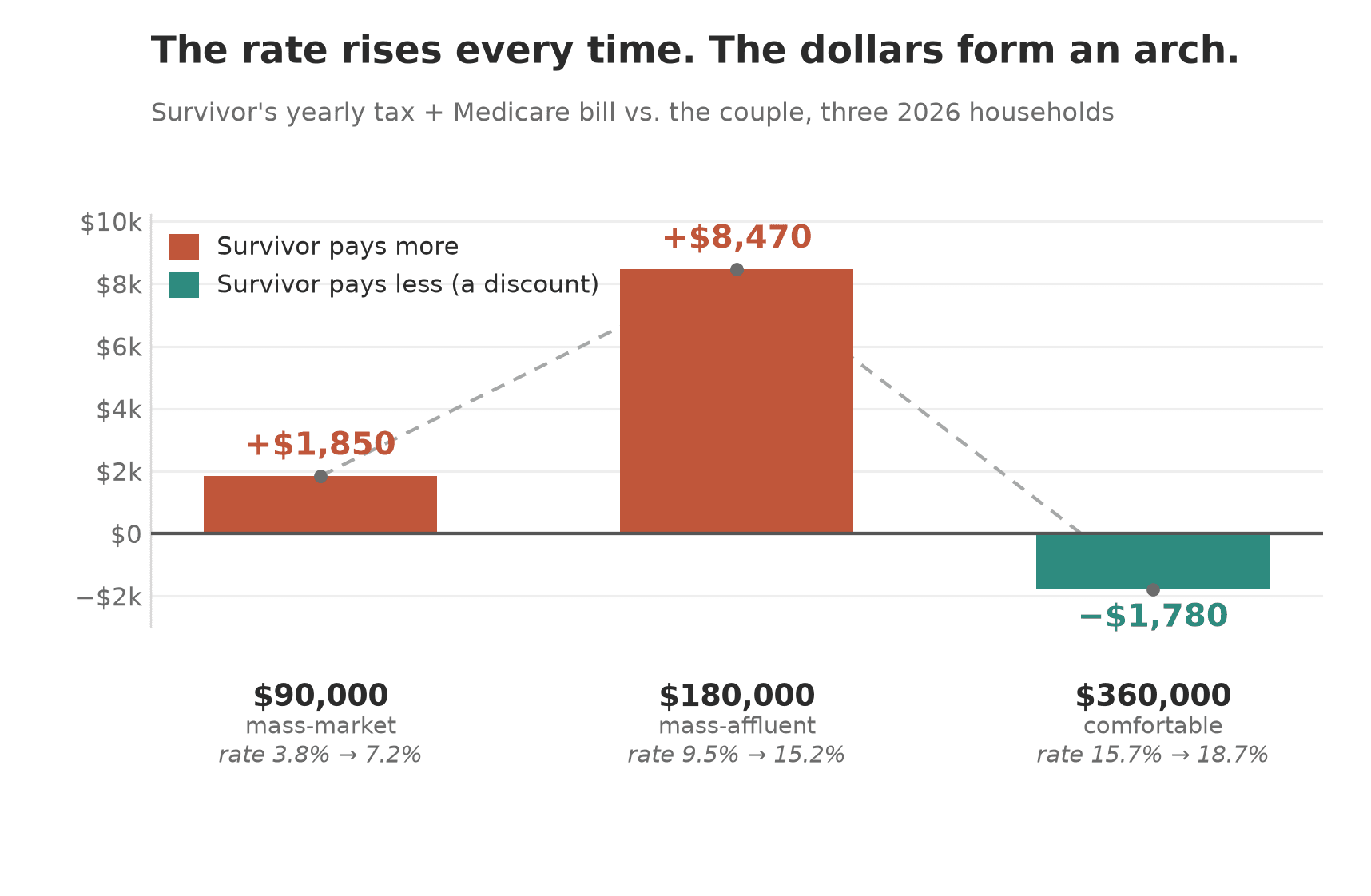
- •At $360,000 the survivor’s combined tax and Medicare bill actually FALLS about $1,800. The couple’s two IRMAA enrollees cost more than one survivor a tier higher.
- •At $180,000 the tax change is decisive: about $8,500 of added tax and IRMAA, which is the difference between clearing a reduced budget and falling short.
- •At $90,000 there is no IRMAA at all, but filing single pushes more Social Security into taxable territory. That torpedo takes about $1,800 from the thinnest cushion of the three.
- •Security is income minus expenses, not a tax rate. A survivor needs roughly 70 to 80 percent of what the couple spent, and in two of the three households that drop mattered more than the tax did.
The “widow tax,” or widow’s penalty, is a frequent talking point in the financial press, almost always framed as a looming hit: the survivor files single, jumps a bracket, loses half the standard deduction, and pays higher Medicare premiums. The framing pushes readers toward Roth conversions and insurance. But the label bundles three different changes: lost income, changed spending, and the tax change, and only the third is the tax code’s doing. It is usually the smallest, and once you account for the fact that a survivor also spends less, it often is not the thing that decides whether the survivor is secure.1
First, pull the bundle apart
When the first spouse dies, three things move. Lost income is usually the largest. Social Security pays the survivor only the larger of the couple’s two benefits; the smaller check stops, so household Social Security falls by roughly a third for a one-earner couple to a half for two equal earners, and a pension may shrink or end.2
Changed spending moves too, and in the survivor’s favor. One person does not need what two needed. The planning rule of thumb is that a survivor needs about 70 to 80 percent of what the couple spent,3 another way of saying expenses fall roughly 20 to 30 percent. That is not a guess; it falls out of household equivalence scales, which find that two people live at about 1.4 times the cost of one, not twice, so one person needs roughly 70 percent of a couple’s budget for the same standard of living.4 The catch is that the reduction is uneven: housing, property tax, insurance, and utilities barely move when the household loses a person, so the realized drop often lands at the smaller end of that range, and a survivor’s own health spending can even rise once a caregiving spouse is gone.5 The practical result is that spending falls, but less than income does.6
The tax change is the third piece: narrower single brackets, a smaller standard deduction, the phase-out of the new senior deduction, and lower Medicare (IRMAA) thresholds. It is the only part the tax code caused, and it is the piece the marketing is built around.
How to read the tables
Each table below separates all three changes. It shows the tax picture, then translates it into cash flow: after-tax income, the survivor’s lifestyle need at 75 percent of the couple’s spending, and whether the survivor’s reduced income covers it. I assume the couple spends its entire after-tax income, a deliberately conservative choice, because a couple that saves leaves its survivor with even more room. All figures use 2026 federal parameters, both spouses over 65, federal tax only.7
Household A: the $360,000 couple
A couple with about $360,000: $80,000 from Social Security, $210,000 from a pension and required minimum distributions, $30,000 in qualified dividends and $40,000 in long-term gains. Both are over 65 and both already pay the Medicare surcharge. One spouse dies; the survivor keeps the larger Social Security check and most of the other income, landing at roughly $308,000.
Only 85% of a Social Security benefit is ever taxable, so $12,000 of this household’s $360,000 never enters taxable income at all. That is why AGI works out to $348,000 rather than $360,000, and it is the single most important number to carry into the table below.
| Couple (joint) | Survivor (single) | |
|---|---|---|
| Total income | ~$360,000 | ~$308,000 |
| Federal income tax | ~$53,900 | ~$55,000 |
| Medicare IRMAA (yr) | ~$9,240 | ~$6,355 |
| Effective tax rate | ~16% | ~19% |
| After-tax income | ~$296,860 | ~$246,645 |
| Lifestyle spending | ~$296,860 | ~$222,645 |
| Surplus / (shortfall) | — | +$24,000 |
Lifestyle spending assumes the couple spends its full after-tax income and the survivor needs about 75% of it. Even at an 80% (stickier-expense) assumption, the survivor still clears the budget by about $9,000.
Read the top of the table and the widow tax looks real: the effective rate rises from about 16 to about 19 percent. Read the dollars and it disappears. Federal income tax rises only about $1,100, while the Medicare surcharge falls about $2,900, because two enrollees deep in the IRMAA tiers cost more than one survivor a step lower, so the survivor’s combined tax and Medicare bill actually drops about $1,800. Now add spending. The survivor’s income fell about $50,000 after tax, but a one-person version of this lifestyle costs about $74,000 less, so the survivor clears the reduced budget by roughly $24,000 a year. At this income the widow tax is not a cost; it is a small discount, and the spending drop turns the whole event into a surplus.
Household B: the $180,000 couple
A couple with $180,000: $60,000 from Social Security and $120,000 from a pension and required minimum distributions, all ordinary income. Both are over 65. One spouse dies; the survivor keeps the larger Social Security check and the full $120,000, landing at $150,000. The entire $30,000 income loss is the smaller Social Security check stopping.
| Couple (joint) | Survivor (single) | |
|---|---|---|
| Total income | $180,000 | $150,000 |
| Federal income tax | ~$17,148 | ~$22,737 |
| Medicare IRMAA (yr) | $0 | ~$2,885 |
| Effective tax rate | ~9.5% | ~15% |
| After-tax income | ~$162,852 | ~$124,378 |
| Lifestyle spending | ~$162,852 | ~$122,139 |
| Surplus / (shortfall) | — | +$2,239 |
At an 80% (stickier-expense) assumption the survivor instead falls about $5,900 short. The ~$8,500 tax hit is what moves the survivor from breathing room to the edge.
This is the band where the tax earns its name and where it actually matters. The survivor’s federal tax rises about $5,600, much of it the new senior deduction losing value against the lower single threshold, and a new IRMAA surcharge of about $2,900 appears from zero, for roughly $8,500 of added tax and Medicare. On the spending side it is nearly a wash: after-tax income falls about $38,000, and a 75-percent lifestyle costs about $41,000 less, so on paper the survivor clears the budget by only about $2,000. That thin margin is the whole story. Take the $8,500 tax hit away and the survivor would have roughly $10,000 of breathing room; leave it in and they are at the edge, tipping into a shortfall of about $6,000 if expenses are sticky and fall only 20 percent.8 This is the one household where the tax change is decisive, not because it is large in the abstract, but because it lands exactly where the cushion is thinnest.
Household C: the $90,000 couple
A $90,000 couple: $38,500 from Social Security, near the national average for two retired spouses, plus $51,500 from a pension and distributions. Both are over 65. One spouse dies; the survivor keeps the larger Social Security check and the full pension, landing at $73,500.
| Couple (joint) | Survivor (single) | |
|---|---|---|
| Total income | $90,000 | $73,500 |
| Federal income tax | ~$3,433 | ~$5,278 |
| Medicare IRMAA (yr) | $0 | $0 |
| Effective tax rate | ~4% | ~7% |
| After-tax income | ~$86,567 | ~$68,222 |
| Lifestyle spending | ~$86,567 | ~$64,925 |
| Surplus / (shortfall) | — | +$3,297 |
At an 80% assumption the survivor falls about $1,000 short; the ~$1,800 the Social Security torpedo takes is what erases the cushion.
There is no Medicare surcharge here and never will be. But the survivor’s federal tax still rises about $1,800 and the effective rate roughly doubles, because filing single pushes more of the Social Security benefit into taxable territory, toward the 85-percent ceiling: the Social Security tax torpedo. In cash-flow terms the survivor covers a 75-percent lifestyle by about $3,300. The trouble is that the margin is small in absolute dollars and the most fragile of the three: if this household’s budget is housing-heavy and expenses fall only 20 percent, the survivor slips about $1,000 short, and the $1,800 the torpedo takes is precisely what erases the cushion. This is the household with the least room to absorb a surprise.
What the three say together
Line the three up and the marketing has it backward twice over. The affluent couple sold protection against the widow tax does not need it: the tax is a discount, and lower spending leaves the survivor comfortably ahead. The lower-income couple nobody is selling to feels a real squeeze, but the mechanism is the Social Security torpedo and a thin absolute cushion, not a dramatic tax. And the middle couple is the one place where the tax change genuinely decides the outcome, where $8,500 is the difference between clearing the budget and falling short.
The deeper point is that the tax was never the right thing to measure on its own. What determines whether a survivor is secure is whether their reduced income covers their reduced expenses, and expenses fall faster than the scary income headline suggests, often faster than income itself at higher incomes. McQuarrie’s finding that the added tax is typically under one percent of a couple’s gross income is not a curiosity; it is the whole case.9 The tax matters only in the narrow middle band, and only because that is where the spending cushion is thinnest.
So the planning follows the cushion, not the fear. At the top, a Roth conversion sold as widow protection is solving a problem that does not exist; defend it, if at all, as an estate or lifetime-bracket decision. In the middle, managing the tax, smoothing income, holding down future required distributions, staying under an IRMAA tier, is worth real money because it is the swing factor. At the bottom, the lever is rarely tax at all; it is income and reserves, because the margin is small no matter what the brackets do. Same event, three different results, and the tax is the headline in only one of them.
See your own three numbers
RetireSmartIRA models the survivor year alongside income tax, IRMAA, and Social Security
Test a survivor scenario on iPhone, iPad, or Mac: see what changes for the survivor before you buy insurance against it. Free through 2026.

Frequently asked questions
Notes
- Edward F. McQuarrie, “Widow Tax Hit Debunked,” Journal of Financial Planning 36, no. 12 (2023): 62–74; working paper “The Widow Tax Hit: Much Ado About Nothing?”, SSRN no. 3896672. McQuarrie finds the survivor’s added income tax and IRMAA is typically less than 1% of the couple’s gross income. Journal of Financial Planning ↩
- Social Security Administration, “Survivors Benefits”: the survivor receives the higher of the couple’s two benefits and the smaller one stops, so household benefits fall by roughly one-third (a one-earner couple) to one-half (two equal earners). ssa.gov ↩
- Financial-planning rule of thumb that a survivor needs about 70–80% of the couple’s spending, i.e. expenses fall roughly 20–30%. The “stickier-expense” case (about 80%, a 20% drop) reflects housing-heavy budgets, where fixed costs barely change. Kiplinger ↩
- Household equivalence scales: the square-root scale implies one person needs about 71% of a couple’s budget for the same standard of living; the OECD-modified scale implies about 67%. Two people live at roughly 1.4 times the cost of one, not twice. Conversable Economist ↩
- Health spending can rise after widowhood: a study of 6,487 older Dutch widows and widowers found mean healthcare spending rose about 48% in the 42 months after a spouse’s death, and more for men and the oldest survivors. PMC ↩
- Fadlon, Ramnath & Tong (NBER Working Paper 25586), summarized in “Financial Life After the Death of a Spouse,” Chicago Fed Letter No. 438 (May 2020): average household income fell from about $75,000 to about $47,000, but after adjusting for one fewer person the decline in individual income was about 11%. Spending needs fall along with the household. Chicago Fed ↩
- 2026 federal parameters: IRS Revenue Procedure 2025-32 (2026 inflation adjustments and the OBBBA senior deduction) and 2026 Medicare IRMAA tiers confirmed by CMS (Nov. 2025). Federal income tax and Medicare only; state tax excluded. ↩
- See note 3: the survivor-needs band is 70–80%. The 80% (20%-drop) case reflects housing-heavy budgets, where fixed costs fall least and the survivor’s cushion is smallest. ↩
- See note 1: Edward F. McQuarrie, “Widow Tax Hit Debunked,” Journal of Financial Planning 36, no. 12 (2023): 62–74. ↩
- See note 3: survivor modeled at 75% of the couple’s after-tax spending, with the 70–80% band noted where it changes the answer. ↩
- See note 7: 2026 federal parameters; state tax excluded. ↩
Get the next article by email
Retirement tax planning, explained in English. No spam, just new articles as they publish, a few times a month at most.